
Why Brochures Crack on the Fold: The Grain Direction Guide
A Technical Framework for Production Engineers
The EGP 100,000 Mistake Nobody Talks About
Last month, a print shop in Cairo ran 15,000 brochures for a luxury hotel. Premium 200gsm coated stock. Perfect color match. Flawless registration.
When the finishing department scored and folded them, every single spine cracked. White fracture lines across a deep burgundy cover. The entire run went into recycling.
The paper wasn’t defective. The press wasn’t miscalibrated. The operator made one invisible decision at the ordering stage: he ignored grain direction.
This guide will make sure you never make that call.
What is Grain Direction? (The 30-Second Version)
Paper is made of cellulose fibers suspended in water, then dried on a moving mesh. Those fibers align in the direction the machine travels—like logs floating downstream.
This alignment creates two fundamentally different axes in every sheet:
| Property | With the Grain | Against the Grain |
|---|---|---|
| Folding | Smooth, clean | Cracks, fractures |
| Feeding | Stiff, stable | Flexible, jams |
| Moisture Response | Minimal expansion | Expands 0.5-1% |
| Tear Resistance | Strong | Weak, ragged |
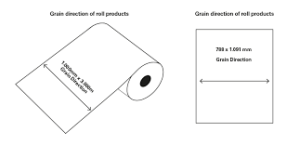
The terminology:
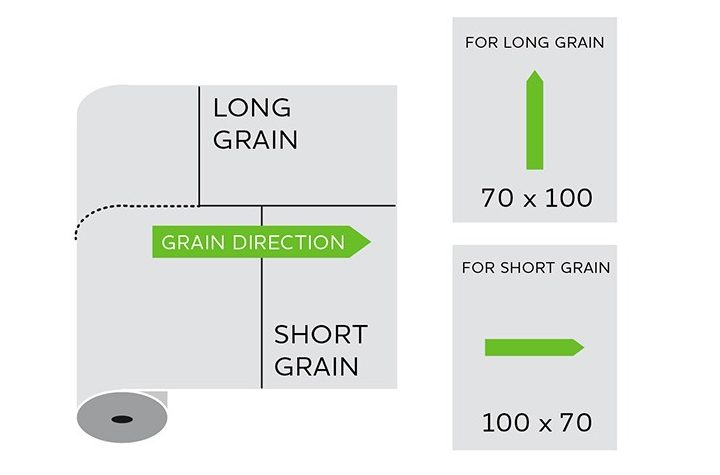
• Long Grain (LG): Fibers run parallel to the sheet’s long edge
• Short Grain (SG): Fibers run parallel to the short edge
That’s the concept. Now let’s talk about why it ruins jobs.
The Three Ways Grain Direction Destroys Print Jobs
1. The Cracking Problem (Finishing Failure)
When paper folds against the grain, you’re asking fibers to snap instead of bend. On uncoated stock, this creates a rough, fuzzy fold. On coated stock above 170gsm, the mineral coating shatters—leaving white stress lines that no amount of scoring will prevent.
The rule: Grain must run parallel to the spine or primary fold.
A 4-page brochure printed on 50×70cm stock? The grain must run along the 70cm dimension if that’s your fold line.
2. The Registration Problem (Press Failure)
Paper absorbs moisture from the air—and from offset ink. When it does, it expands across the grain, not along it.
On a 4-color offset run, this means:
• Sheet absorbs moisture at Unit 1
• Expands 0.3mm by Unit 2
• Expands 0.5mm by Unit 4
• Final print: colors don’t align
This is called fan-out, and it’s the reason your cyan plate looks “loose” on one axis but perfect on the other.
The rule: On multi-color offset, grain should run perpendicular to the gripper edge to minimize visible fan-out.
3. The Feeding Problem (Digital Failure)
Digital presses with fuser temperatures of 180-220°C create a different conflict. The sheet must be rigid enough to pass through the fuser nip without buckling.
Grain-long feeding provides that rigidity. But if you’re producing a booklet, grain-long feeding means the grain runs perpendicular to the spine—and your pages won’t lay flat.
You can’t win both. You have to choose which failure mode you can live with.
🔗 The trade-off explained: Read: Digital Fuser Conflicts and the Mousetrap Effect (Deep Dive)
Quick Test: How to Identify Grain Direction in 10 Seconds
The Bend Test:
- Hold the sheet horizontally by one edge
- Let it droop naturally
- Rotate 90° and repeat
- The stiffer direction = grain direction
That’s it. Paper resists bending along its grain. The floppy direction is cross-grain.
The Decision Matrix You Actually Need
• 12 press models (offset + digital)
• Weight ranges from 60gsm to 350gsm
• Finishing requirements (fold, perfect bind, saddle stitch)
Stop Guessing. Start Engineering.
Grain direction isn’t a detail—it’s a structural decision that determines whether your job succeeds or becomes an expensive lesson.
The professionals who never have cracking, registration, or feeding problems aren’t lucky. They’re making informed decisions at the specification stage.
Already registered? Log in to access tools